
Why Great Marketing Isn’t Enough to Grow Your Business
Everything was bright green; website traffic was up, social engagement was climbing, email open rates were double industry averages. The marketing team had crushed it over the last few months. Yet, when the team switched to the revenue report, everything went red: flat growth, missed projections…the faces of the leadership team.
“Our marketing metrics have never been better, but revenue hasn’t moved.”
Sound familiar? This is a very real statement heard time and time again.
If you’re like a lot of business leaders, you’ve built sophisticated campaigns, assembled talented teams, and maybe even put billboards up that make your competitors burn with jealousy. But your business remains stuck, with a growing disconnect between your marketing success and revenue reality.
What if the problem isn’t execution? What if the real solution is one level deeper and ten times more powerful?
Breaking through your growth ceiling requires more than marketing – it demands an entirely different approach to how your business thinks about revenue generation.
Five Signals Your Revenue System Is Broken
How do you know the problems you’re facing are your revenue engine and not just a bad campaign? When it’s your revenue engine, the warning signs aren’t subtle. You’ll notice these five red flags:
1. Sales and Marketing Blame Each Other
Marketing blames sales for not following up on leads. Sales insists the leads are garbage. This isn’t just typical office poli-tics—it’s a system failure. Without shared goals, definitions, and metrics, these departments naturally work at cross-purposes.
2. You’re Data Rich, But Insight Poor
Your dashboards overflow with impressive (vanity) metrics, yet the questions that actually matter remain unanswered:
- Which marketing activities actually drive revenue?
- Why do certain leads convert while others languish?
- Where exactly do prospects drop out of your funnel?
3. You Can’t Get Off the Campaign Treadmill
Your teams constantly develop new campaigns, content, and initiatives. Each one launches with fanfare and promising early metrics. Yet the impact on revenue? Virtually zero.
This endless “campaign treadmill” keeps everyone busy churning out random acts of marketing that rarely move the growth needle. It’s exhausting, expensive, and completely ineffective.
4. Your Tech Tools Aren’t on Speaking Terms
Your marketing automation, Customer Relationship Management (CRM), customer service, and analytics platforms all contain valuable data. The problem? These systems don’t talk to each other, which creates dangerous blind spots in your customer journey, allowing leads to fall through the cracks between systems. Do you really know where the bottleneck is? Meanwhile, teams waste hours manually transferring information or making decisions based on incomplete data.
5. Your Budget Conversations Are Tense
As growth plateaus, budget conversations become increasingly tense; market-ing struggles to justify spending without clear revenue attribution; sales demands more resources while blaming external factors for missed targets.
Without a unified approach to measuring revenue impact, these conflicts intensify as growth slows, creating a downward spiral that reinforces silos and further ce-ments your growth ceiling.
You Don’t Need Traditional Marketing. You Need a Growth Engine
So what’s the solution to your broken revenue system?
It’s not more marketing campaigns. It’s not better CRM. It’s not another agency specializing in the latest social trend. And please don’t think you’re going to make a viral video to solve your revenue problems. The breakthrough is a completely different approach to revenue generation. Enter the growth team model.
What a Growth Team Is Not
- A marketing team with a trendy new name
- A sales team that learned some digital tricks
- A customer success team that dabbles in marketing These approaches just reinforce the same broken system.
What a Growth Team Actually Does
A growth team aligns your marketing, sales, and customer success functions into a single, cohesive revenue engine (also read, a unified customer experience). It breaks down the silos throttling your growth and replaces them with integrated systems designed for predictable revenue generation.
The differences are stark:
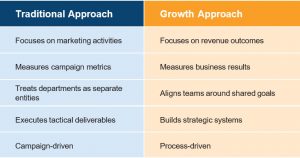
This Isn’t Just New Terminology – It’s a Complete Transformation
This shift demands a fundamentally different skill set, process, and accountability structure. Growth agencies combine marketing expertise with sales operations knowledge and customer success insights to create integrated strategies almost impossible under traditional models.
The most powerful part? This approach transforms marketing from a cost center into a predictable driver of business growth – exactly what it was always meant to be.
The Growth Transformation Process
Here’s how a growth process typically unfolds:
Phase 1: The Revenue Ecosystem Audit
A growth team begins by examining your entire revenue operation:
- How leads actually flow from marketing to sales – and where they get stuck.
- Which marketing activities influence closed deals (not just generate leads).
- How your technology systems connect (or fail to connect) across departments.
- Where customer feedback loops break down between service teams and marketing.
- Which metrics each team uses and how they align with revenue goals.
Examining these operations reveal bottlenecks most businesses never identify – the hidden friction points where potential revenue leaks from your system. Switching your perspective from a traditional marketing funnel focused on net new to the “bow tie” (funnel which looks at the customer journey) holistically helps identify where growth comes from. Hint: it might not be new if churn is high.
Phase 2: Strategic Growth Planning
With a clear understanding of your revenue ecosystem, a tactical plan helps align marketing, sales, and customer success. But this isn’t a traditional marketing plan focused on campaigns and channels. This roadmap:
- Establishes shared definitions, goals, and accountability across departments.
- Identifies and prioritizes improvements based on revenue impact, not just marketing metrics.
- Integrates sales enablement and customer success strategies with marketing tactics.
Phase 3: Implementation with a Proven Process
Here’s the truth: most businesses don’t need another strategy document. They need a proven framework for executing revenue transformation once strategy is set. This is where Agile project management becomes essential for growth teams. Unlike traditional marketing campaigns with fixed timelines and rigid deliverables, growth team implementation uses Agile sprints to rapidly test, learn, and iterate on revenue system improvements.
Growth teams organize work into two-to-four-week sprints, each focused on specific revenue hypotheses within the larger growth strategy and established projects. One sprint might test new lead scoring criteria between marketing and sales. Another might experiment with customer success feedback loops that inform acquisition messaging.
This methodology ensures growth initiatives maintain momentum, adapt quickly to discoveries, and deliver measurable revenue impact rather than getting stuck in endless planning cycles or abandoning them after initial launch enthusiasm fades.
Phase 4: Continuous Measurement and Optimization
Traditional marketers may want to launch “one and done” campaigns. Growth teams implement cycles of measurement and refinement:
- Regular reviews of leading indicators linked to (lagging) revenue outcomes.
- A/B testing focused on conversion improvements, not just engagement metrics.
- Cross-functional optimization sessions where marketing, sales, and customer success collaborate.
- Systematic elimination of bottlenecks as they’re identified.
The result isn’t just better marketing – it’s a transformed revenue engine where marketing activities translate directly to business results, sales teams receive qualified opportunities instead of raw leads, and customer success insights feed back into acquisition strategies.
The Growth Ceiling Breakthrough: Your New Business Reality
What happens when this transformation takes hold?
The impact extends far beyond better marketing metrics. Your entire organization experiences a fundamental shift in how it functions, creates value, and grows.
Business Growth Becomes Systematic
You’ll no longer hope individual initiatives drive results. Instead, you’ll operate with clarity about which actions reliably generate business outcomes, creating a new operational rhythm where growth isn’t dependent on marketing heroics or sales talent. It emerges naturally from well-designed systems that consistently convert prospects to customers to advocates.
Decision-Making Transforms
With an integrated revenue approach, you’ll make growth decisions from a position of unprecedented clarity:
- Investment choices based on projected revenue impact, not departmental requests.
- Resource allocation driven by data rather than opinions or politics.
- Technology selections evaluated on end-to-end revenue impact, not departmental preferences.
- Hiring priorities determined by system needs rather than departmental headcounts.
This evidence-based approach eliminates much of the politics and guesswork from growth decisions, allowing your leadership team to act with confidence rather than hope.
Organizational Culture Realigns
Perhaps the most profound transformation occurs in company culture – the traditional tensions between marketing, sales, and customer success give way to collaborative momentum around shared outcomes. Cross-functional collaboration becomes the norm rather than the exception, and departmental success is measured by contribution to revenue goals rather than activity metrics.
Competitive Advantage Emerges
While your competitors continue struggling with fragmented approaches and departmental silos, your business operates from an integrated framework designed for sustainable growth. This creates a significant competitive advantage that extends beyond marketing performance to impact your entire business model.
Your competitors can copy your products, your pricing, even your marketing messages – but they can’t easily replicate your integrated revenue engine. It becomes your greatest sustainable advantage in the market.
The Bottom Line: Your Path Forward
The harsh reality? The disconnect between impressive marketing metrics and disappointing revenue results isn’t just bad luck. It stems from a fundamental flaw in how businesses structure their growth operations.
The growth team model addresses this systemic issue by:
- Breaking down departmental silos that limit your growth potential.
- Building integrated systems where every activity connects directly to revenue.
- Aligning teams around shared goals with clear accountability for outcomes.
- Implementing end-to-end measurement based on business impact, not departmental metrics.
This isn’t just a minor adjustment to your marketing approach. It’s a complete revolution in how your company generates growth. If you’re facing your own growth ceiling, remember: breaking through isn’t about working harder within a broken system – it’s about having the courage to build a better one.
By Jennifer Jurgens, Founder and CEO of 1 Bold Step; originally published in SBAM’s November/December 2025 issue of FOCUS magazine
Click here for more News & Resources.