Article courtesy of MIRS for SBAM’s Lansing Watchdog newsletter
The U.S. Army Corps of Engineers (USACE) approved a key federal permit for Enbridge Energy’s Line 5 tunnel, despite acknowledging environmental and cultural impacts.
The Canadian-based Enbridge immediately praised the move while Michigan’s tribal leaders slammed the decision, noting that construction remains delayed after the Michigan Supreme Court recently ordered the Michigan Public Service Commission to redo its analysis.
“The approval of this key federal permit for the Great Lakes Tunnel Project is a significant step forward and reflects the U.S. Army Corps of Engineers’ more than six years of rigorous, comprehensive review,” Enbridge spokesperson Ryan Duffy said. “Enbridge is committed to protecting the Great Lakes, the region’s natural and cultural resources, and the waterfront communities that depend on them, while also ensuring reliable energy for the region.”
Whitney Gravelle, president of the Bay Mills Indian Community, and David Holtz, coalition coordinator for Oil & Water Don’t Mix, criticized the decision, with Holtz calling it a “thoroughly flawed product of a rushed process driven by the Trump administration’s phony ‘national energy emergency.’”
The Trump administration’s accelerated “Building Infrastructure, No Paperwork” initiative sought to expedite the permitting process for critical energy projects.
“Today’s decision by the U.S. Army Corps is more than a procedural failure; it is a profound breach of the United States’ treaty trust responsibility to Tribal Nations,” Gravelle said. “Our treaties are solemn promises that carry the highest legal and moral obligation, yet the Corps cast that aside . . .
“Instead of honoring the commitments embedded in the 1836 Treaty of Washington, they chose to treat Tribal Nations as an obstacle rather than as sovereigns whose rights must be honored — all to advance Enbridge’s interests at the expense of our homelands, our waters, and the Great Lakes,” Gravelle added.
In the record of decision, Katie Otanez, regulatory project manager, notes that after consideration of the environmental impacts and alternatives to the project, it is her “determination that the proposed project is not contrary to the public interest” and the permit should be issued, with special conditions, including clearly marking construction boundaries and use of erosion controls, such as fencing; filling areas completely removed and native topsoil replaced; among others.
The Army Corps said the tunnel would provide protection from vessel anchor strikes and secondary containment in the event of a pipeline release. Those safety benefits were central to the agency’s conclusion that the project’s public benefits outweigh its environmental and cultural costs.
“Tribal Nations’ resolutions and submissions expressed that the presence and continued operation of the Line 5 pipeline crossing the Straits represents a threat to the welfare of the people,” Otanez wrote. “However, none of the decision options available to USACE would prohibit operation of the existing pipeline.”
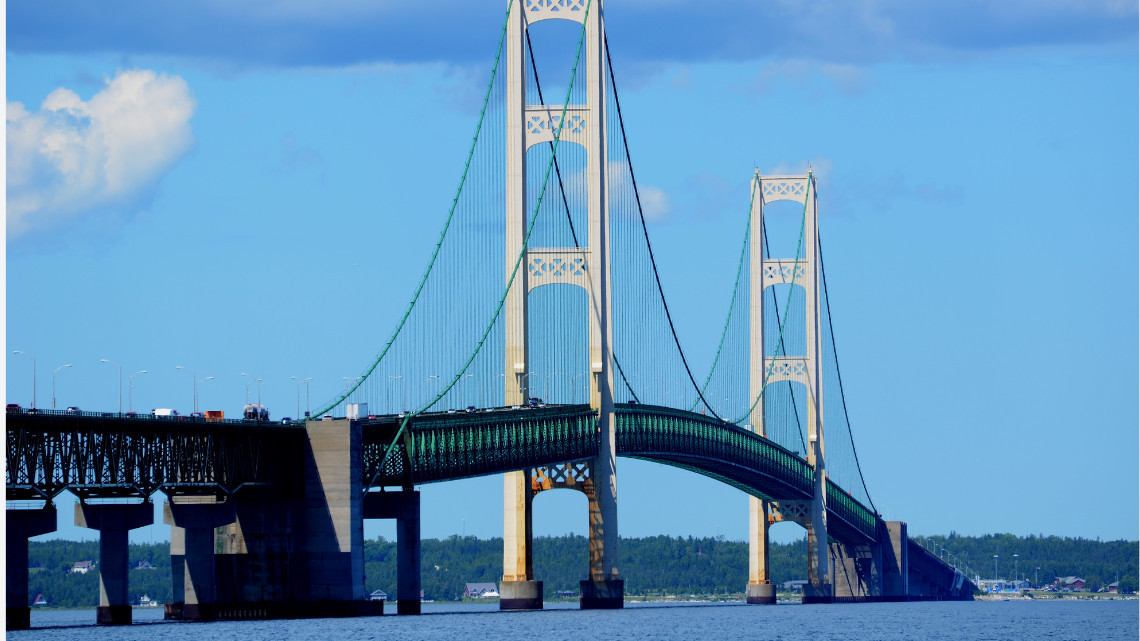
Enbridge proposes to build an estimated 3.9-mile tunnel through bedrock beneath the Straits of Mackinac.
The company’s preferred alternative is to excavate about 364,000 cubic yards of material in the bedrock beneath the lakebed to create a roughly 21-foot-diameter tunnel to house a new 30-inch segment of Line 5, replacing two existing 20-inch pipelines that lie on or beneath the lakebed. It also includes decommissioning the existing dual pipelines in place.
The Corps found the preferred alternative would affect two federally threatened plant species, Houghton’s goldenrod and dwarf lake iris, as well as wetlands and other vegetation. The report specifically identifies permanent loss of 0.78 acres of wetlands and temporary impacts to another 0.22 acres.
The Corps also considered a no-action alternative, but Otanez concluded it “does not meet the overall project purpose” and would not provide infrastructure safety measures intended to reduce environmental risks.
Line 5, which is about 645 miles long, carries about 540,000 barrels a day of crude oil and natural gas liquids between Superior, Wisconsin, and Sarnia, Ontario.
Click here for more News & Resources.