As many Michiganders headed up north to celebrate America’s 250th birthday, Michigan’s legislature gathered deep into the night Thursday and early Friday morning to pass their budget for the upcoming fiscal year. While lawmakers did not meet the July 1st statutory deadline they were aiming for, this year’s budget arrived earlier in the year than any budget since 2018.
The budget amounted to $75.2 billion. Legislators touted things like the highest per pupil increases in the education budget ever, to numerous project allocations across the state, childcare investments, small business supports and everything in between – it was a marathon session to reach a compromise between the Senate and House. The budget bills now head to the Governor’s desk for evaluation and signature.
MI Tri-Share Program
Many policy bills were run alongside the budget this year. One being HB 6043 (Rep. VanWoerkom – Norton Shores), that codifies the MI Tri-Share program into law giving it a much firmer footing for future years rather than going through the appropriation process. As an organization that has supported MI Tri-Share from its inception, it was imperative for us to get this cemented now that it has gone from idea, to pilot to full implementation with success. It is a unique and first of the kind program that convenes employers, employees and state government to each take a third of childcare payments as a workforce development tool to attract and retain talent while also helping find affordable and quality childcare for Michigan’s families. It also assists in providing certainty in the childcare industry that has been fragile with heightened awareness throughout the pandemic. We could not be more thrilled to see this pass as it was a priority for the advocacy team this year. Mi Tri-Share was fully funded at $3.4 million. Rep. VanWoerkom has been a steady leader and champion for us in this space, and he once again delivered on this initiative alongside his colleagues in both the House and the Senate.
Pure Michigan
Once again, Pure Michigan funding took a hit in this year’s budget. Last year, it was allotted $16 million. This upcoming fiscal year, the program will receive $11 million. We know that this program is essential to driving tourists to our respective communities throughout Michigan and brings a deep sense of pride to our state. While our recommendation was to increase this funding back to its height of $25 million – legislators were dealing with deficits in other departments that didn’t allow for maintaining last year’s allocation.
Michigan Reconnect
Michigan Reconnect provides scholarships to students aged 25 and older (it was temporarily expanded to include 21 and older a few years ago) to complete an associate degree or skills-based certificate. This program is a vital tool to improve the skilled workforce.
In this year’s budget the legislature expanded Reconnect funding by $25 million to support permanently expanding Michigan Reconnect to adult learners ages 21 and older, giving adult learners a tuition-free pathway to earn an associate degree or skilled trades certificate. More than 66,500 students have enrolled in community college with Michigan Reconnect since it was created in 2021. Total program funding for this year is $67 million.
Going PRO Talent Fund
Michigan’s Going PRO Talent Fund provides competitive awards to employers for training, developing and retaining current and newly hired employees. Since the program’s inception in 2014, tens of thousands of employees have received vital and relevant training that has not only helped the development of their careers but has also been a vital resource for participating small businesses.
The program experienced significant cuts in the FY 26 Budget and did yet again in this year’s budget going from $31.8 million to $14.5 million. At the start of budget negotiations, the Senate left this program completely out of its recommendation for continuation, but the Speaker of the House rebutted that. As we can see, this program was essentially cut in half and over the last 3 cycles of budgeting has seen a major reduction from it’s height of $54 million – a sign of the times that priorities and shortfalls in other areas have taken priority.
Small Business Supports
Michigan’s FY 2026 Budget approved $59.35 million for business attraction and community revitalization, which designated $11.2 million specifically set aside for the Small Business Support Hub program. This program is designed to provide direct support and training opportunities to small businesses. The SBAM Foundation participates in this program as a statewide hub, delivering training, education, and support services to small businesses across the state with a focus on small business owners delivering the services to their peers.
The FY 27 budget, passed Friday morning, set aside $68.23 million for a newly created fund, called the “Michigan small business, community growth, and entrepreneurship support.” The fund is broken down into three parts, with the majority of funds dedicated to promoting small business growth both in second-stage businesses and startups. The funds are broken down as follows:
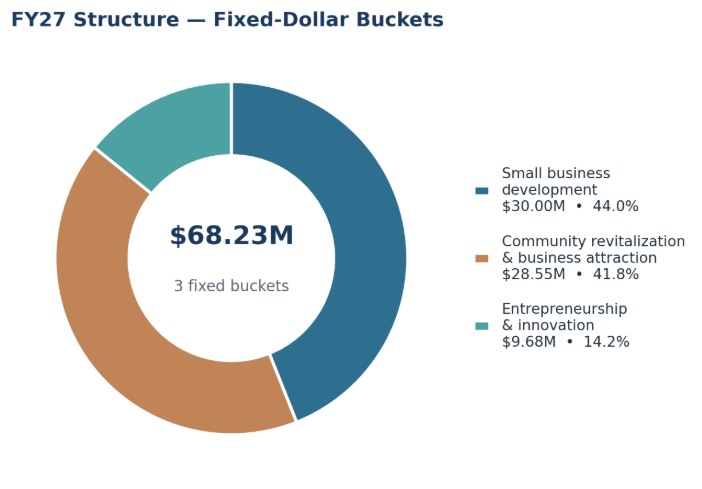
Bucket 1: Small business development: $30,000,000
- Assistance to small business support hubs & community incubators
- Business development grants and loans to small businesses
- Support for community development financial institutions
- Grants and loans to small business service providers
- Technical assistance for small businesses
- Matching funds for federal grants/programs benefiting small businesses
- Grants to hubs connecting Michigan entrepreneurs/small businesses to global markets (new export orientation)
Bucket 2: Community revitalization & business attraction: $28,550,000
- Michigan community support: brownfield redevelopment & historic rehabilitation; revitalization of vacant/blighted buildings; place-based infrastructure for social zones and traditional downtowns
- Michigan business growth support: expansion, retention & attraction of eligible businesses making capital investments and creating jobs; industrial site development, community planning, and infrastructure for local governments and economic development organizations
Bucket 3: Entrepreneurship & innovation: $9,684,500
- Technology transfer from universities to the private sector for commercialization
- Technical assistance for high-tech startups & early-stage companies
- Matching funds to access federal funding programs
- Grants/loans to business incubators & accelerators supporting high-tech startups
Budget Tidbits
- $200 million to continue free school meals for public school children
- Continuation of the Working Families Tax Credit
- No state tax on tips, overtime and social security
- $502 million on literacy efforts that stemmed from the Governor’s State of the State Address back in February (PreK for All, before and after school programming, tutoring, etc.)
- $2.2 billion to maintain the university and college apparatus to advance Michigan’s Sixty by 30 goal (60% of Michigan’s adults having a certificate or degree by 2030)
- Revitalization of the Transformational Brownfield Program
SBAM’s Advocacy Team recently provided an overview of the state legislative budget and what it could mean for Michigan’s small business community. Watch here.